JobNimbus
Compare directly with AccuLynx; make the inspection handoff the deciding demo.
A documentation-based comparison of roofing, field-service and construction CRMs: pricing posture, inspection tools, integration gates and the work a custom system could remove.
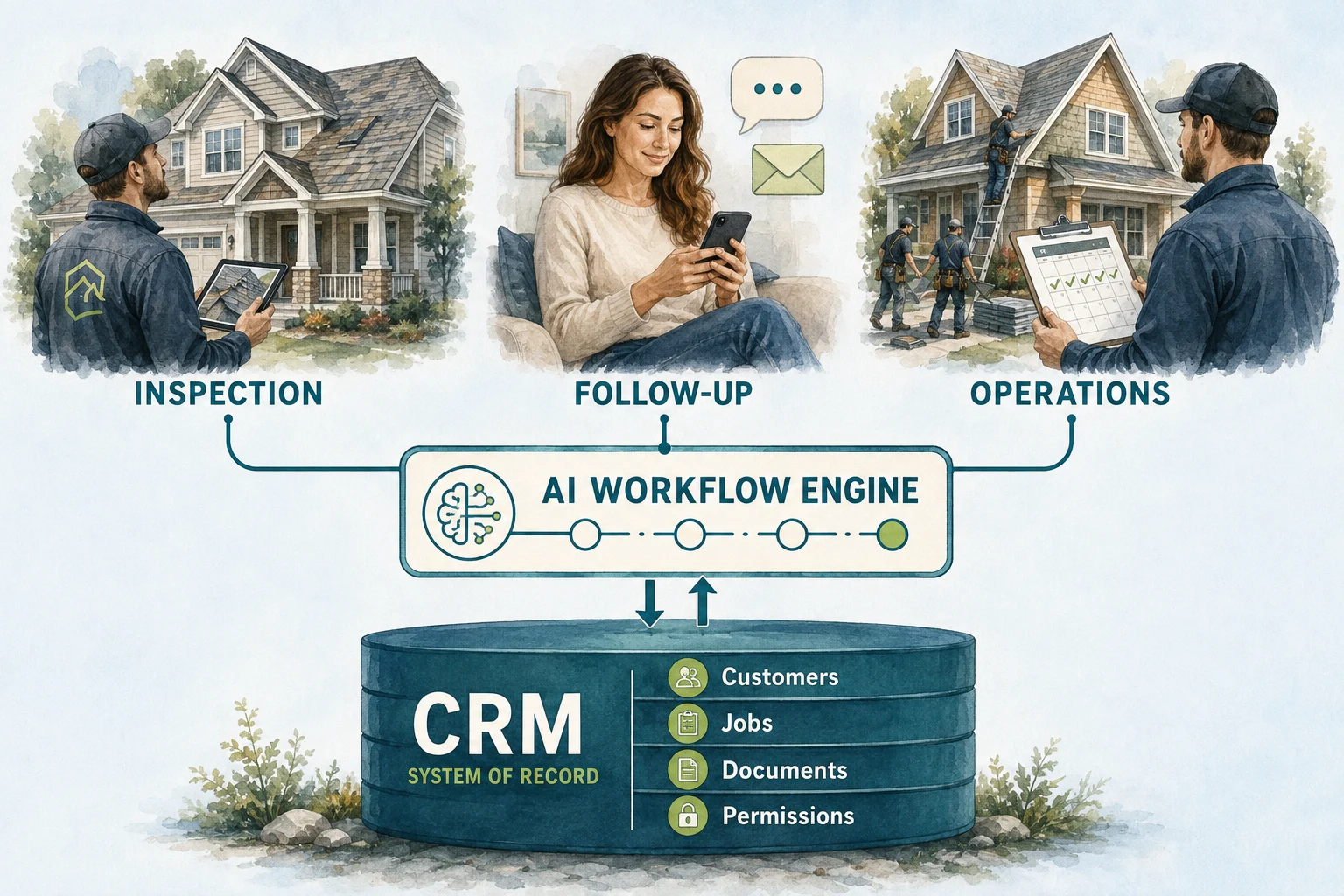
A technician should describe a finding once. The inspection should preserve the evidence, the estimator should receive the approved context and the office should know the next action. Making that happen matters more than which screen holds the original note.
AI can organize observations, draft a report, summarize a conversation or route a question around the CRM. The CRM still controls customer identity, job history, permissions and the operating record. If the source contains duplicates or unclear ownership, the AI layer inherits the confusion.
There is no universal winner. A roofer managing supplements, an HVAC fleet and a remodeler running six-month projects require different foundations. Our recommendations below are starting points for a serious demo—not claims based on market share or paid placement.
These are our documented-fit verdicts. Final selection still depends on your account structure, trade, devices and one end-to-end workflow test.
Compare directly with AccuLynx; make the inspection handoff the deciding demo.
Straightforward operating fit, public pricing and a scoped developer platform.
Strong value and unlimited paid-plan users; test the real crew’s devices.
Broad operating depth with tenant, scope and implementation requirements.
Public flat monthly tiers; Open API begins on Pro.
Project depth is the appeal; test the return path into marketing.
Communications are close to dispatch; Open API is on Ultimate.
Public prices are starting points, not implementation budgets. Quotes, add-ons, payment fees, onboarding and annual terms can materially change the total.
| CRM | Price posture | Forms / field evidence | Custom workflow gate |
|---|---|---|---|
| JobNimbus ↓ | Custom quote; Essentials includes 3 users, Pro 10 and Premium 19 | Native Forms, photos and naturalForms integration | API and webhooks shown across current plans |
| AccuLynx ↓ | Custom quote | Roofing photos, measurements and job documents; validate the exact inspection workflow | Administrator key; every location connected separately |
| Jobber ↓ | Public plans starting at $29/month; pricing changes with users and term | Checklists with questions, images and signatures on select plans | Open API with scopes; broad app distribution needs approval |
| Housecall Pro ↓ | Starts at $59/month billed annually; confirm users, add-ons and MAX pricing | Native job checklists and templates | Available on MAX; not every product feature is exposed |
| ServiceTitan ↓ | Custom, per-technician pricing across Starter, Essentials and The Works | Customizable forms and automated checklists | Scoped application access with customer-enabled tenant IDs |
| Workiz ↓ | Custom quote; Standard, Pro and Ultimate | Checklists on Ultimate | Open API on Ultimate; documented webhooks cover selected record types |
| FieldPulse ↓ | Custom, seat-based quote; premium capabilities priced separately | Conditional custom forms and internal-only fields | Broad REST resources; webhook setup requires FieldPulse Support |
| Service Fusion ↓ | $245 Starter, $382 Plus or $627 Pro per month; unlimited users | Job photos; custom documents included on Pro and available as add-ons below | Open API on Pro |
| Buildertrend ↓ | Custom quote; unlimited users and projects | Daily logs, photos, custom fields and visibility controls | Marketplace integrations; confirm any broader custom access before scoping |
| ServiceM8 ↓ | $0 to $349/month based on job volume; paid plans include unlimited users | Electronic forms, conditional skipping, photos, signatures and PDF reports | Developer program and documented API; validate required write paths |
Our first roofing demo when inspection-to-estimate handoff is the main test
JobNimbus already has native Forms, photo tools and a naturalForms integration. naturalForms can prepopulate CRM data, return a completed form as an attachment and update contact or job information. That is meaningful field capability, so “JobNimbus has no inspection tool” is too broad.
The important boundary is between separate document mechanisms. JobNimbus says Template Questions work only in Document Templates and not in Legacy Estimates, Legacy Invoices, email templates, legacy material or work orders, or the New Sales Experience. naturalForms also requires its own account, and JobNimbus documents one linked naturalForms account per JobNimbus account.
A roof inspection may be complete while the estimator still reads a report and rebuilds the scope. The buyer should test whether the exact answers, measurements and approved findings reach the estimating path—not merely whether a PDF attaches to the job.
Official sources: Pricing and plan limits ↗ · Template Questions boundaries ↗ · naturalForms capabilities ↗ · naturalForms setup ↗
The roofing-production counterpoint to JobNimbus, especially for supplements and branch reporting
AccuLynx exposes roofing-specific data through its API, including supplements. Its developer documentation distinguishes simpler Zapier connections from Advanced API access. That makes it a serious system of record for roofing rather than a generic CRM with a roofing label.
An active account and administrator-provided API key are required. AccuLynx says each location in a multi-location organization must be connected separately. Its supplements endpoint is also location-based.
A head-office dashboard can look complete while silently missing a branch. Field conventions, credentials and connected locations must be explicit in every roll-up.
Official sources: Pricing request ↗ · API access and locations ↗ · Supplements endpoint ↗
Our clearest all-around shortlist for a small or growing service team
Jobber Checklists, formerly job forms, support questions, images and signatures and can attach to jobs or assessments. Customers can receive a PDF. Jobber also offers quote follow-up, reminders and a growing set of native AI and marketing add-ons.
Checklist availability depends on plan. Creating custom-field definitions through the API requires the Custom Field Configurations scope. Jobber also limits draft custom integrations to five paying accounts, so a successful one-company pilot is not the same as an approved multi-client product.
The checklist may already solve field capture. The custom opportunity is often turning a selected answer into a reviewed office action while preserving the evidence and customer outcome.
Official sources: Current pricing ↗ · Native Checklists ↗ · Custom-field permissions ↗ · Custom integration limits ↗
A strong operational shortlist when the MAX-plan API requirement fits the budget
Housecall Pro documents job checklists, checklist templates and completion controls. Its core product covers scheduling, dispatch, estimates, invoices and customer communication. Configure those capabilities before replacing them.
Housecall Pro says API access is on MAX, that not every product feature can be integrated through the API and that it does not provide a dedicated engineer for custom API development.
The project may require both a subscription decision and independent integration ownership. A feature visible in the employee app is not automatically available to external software.
Official sources: Current price overview ↗ · API availability and limits ↗ · Checklist documentation ↗
The enterprise-scale choice here; buy it for the operating platform, not merely for an API
ServiceTitan already combines dispatch, call booking, estimates, pricebook, forms and reporting. Its Forms API release notes describe submission fields, including field-path identifiers. The opportunity is to use this operating data more effectively, not to assume the platform lacks core field tools.
ServiceTitan’s third-party app guidance requires declared scopes, connected tenant IDs and customer enablement. Reading a form submission does not establish permission to change an estimate, schedule or financial record.
A management assistant must preserve departmental approvals and explain unavailable data. “Connect everything” is not a scope; every read, proposed action and write needs an owner.
Official sources: Plans and pricing model ↗ · Forms API release notes ↗ · Application and tenant access ↗
The phone-first shortlist, with an Ultimate-plan gate for open API work
Workiz offers scheduling, estimates, jobs, a communications suite and Genius AI add-ons. Its own automation and phone products should be evaluated before adding another provider.
The current pricing page puts Open API and checklists on Ultimate. Workiz’s webhook guide limits automation triggers to jobs, leads, invoices and estimates. Those record triggers are not proof of a complete event stream for every external conversation.
If a homeowner calls back while tomorrow’s follow-up is queued elsewhere, a job-status trigger alone may not stop the message. The reply source and record-matching rule matter.
Official sources: Plans and API gate ↗ · Webhook events ↗ · Developer platform ↗
The custom-forms shortlist; validate the event that moves a completed form into office work
FieldPulse already advertises conditional logic in custom forms, including show-or-hide questions and internal-only fields. A custom app is not justified merely because an inspection needs branching questions.
Its webhook documentation covers jobs, estimates and invoices and says configuration must be facilitated by FieldPulse Support. The documented surface does not promise an event for each individual custom-form answer.
A failed-inspection workflow needs a dependable trigger. If an answer-level event is unavailable, the build must use a supported completion signal and retrieve the reviewed data through an approved path.
Official sources: Current pricing model ↗ · Conditional forms ↗ · Webhook scope and setup ↗
The clearest unlimited-user value comparison, with API access reserved for Pro
Service Fusion covers scheduling, dispatch, estimates, invoicing and customer management with unlimited users. Its higher plans add job costing, communications and custom documents; ServiceCall.ai is also listed as an add-on.
Open API Integration is included on the $627-per-month Pro plan. Lower-tier feature add-ons do not imply general API access.
A custom equipment or estimate follow-up system may depend on an upgrade before development begins. Compare native capability, plan cost and custom ownership as one operating decision.
Official sources: Current plans and pricing ↗ · API models ↗
The project-management choice, with extra scrutiny on data returning to sales and marketing
Buildertrend documents daily logs with custom fields and visibility controls plus marketplace connections to sales and accounting systems. It already has strong project communication; reproducing that is not the default custom opportunity.
Buildertrend’s HubSpot page says the sync initially flows from HubSpot to Buildertrend, with two-way sync described as a future iteration. The current marketplace guide documents selected lead statuses and field mappings. Confirm current behavior in the demo.
Importing a lead does not prove that completion, reopened work or customer issues return to marketing. A referral campaign can launch at the wrong time if it cannot see the project’s real state.
Official sources: Current pricing model ↗ · HubSpot sync direction ↗ · Marketplace mappings ↗ · Daily logs ↗
The budget-value leader, provided its iOS-centered field experience fits the crew
ServiceM8 Forms support photos, signatures, conditional question skipping and PDF reports stored with the job. The platform also lists AI photo tagging and video transcription. There is substantial native capability to configure first.
ServiceM8 describes its full-featured app as optimized for iPhone and iPad. ServiceM8 Lite for Android provides core features for technicians, subcontractors and temporary workers; ServiceM8 still recommends iPhones for main field technicians who need advanced capabilities.
The inspection can work in an office demo and fail operationally when the actual subcontractor uses a different device. Hardware and field-role testing belong in the buying decision.
Official sources: Current plans and job limits ↗ · Forms and reporting ↗ · Android Lite positioning ↗ · Native mobile and AI features ↗
The JobNimbus example is not “build another form.” The useful question is whether a reviewed field observation becomes usable estimating and follow-up context.
A generic field can collect “flashing problem.” A designed inspection asks where, what was observed and which photo supports it. A required close-up can prevent an incomplete submission; it cannot prove the physical assessment is correct. Voice transcription can save typing, but the technician should confirm the structured result.
The customer report explains approved observations. The estimate adds quantities, products, labor and authorized prices. Those outputs require different approvals. When line-item write access is unavailable, a reviewed estimator package and task can still remove reconstruction work without pretending the estimate was created automatically.
After delivery, the next call, text or email can address the chimney-flashing question. Record the outcome, link the approved evidence and set a next attempt or human task. Stop the applicable sequence when the customer responds, declines or signs. Our estimate follow-up guide shows that communication record in detail.
A successful automation run is not sufficient if the wrong job received the result. Verify the source record, generated output and destination record in a small authorized pilot.
Considering building the inspection tool with AI? Our guide to finishing an AI-built business app follows the permissions, approval and recovery work needed before your team depends on it.
We reviewed official pricing pages, product help centers, integration guides and developer documentation. “Documented boundary” means a published access condition or limitation. “Custom build” is our analysis of a process worth evaluating; feasibility still depends on the customer’s account and a scoped technical check.
The list is ordered to make the comparison readable, not by market share, affiliate payment or a fabricated score. GoodHandoff has a commercial interest in custom workflow work, so we make that perspective explicit and recommend native configuration first when it fits.
We did not conduct hands-on testing of all ten products. Missing public documentation is treated as unconfirmed, not proof that a feature does not exist. Pricing and plan access change; confirm the linked information with each vendor before purchasing.
AI can replace some manual interaction and coordination. A contractor still needs a reliable home for customer identity, job history, permissions and approved operational records. Replacing that foundation is a much larger project than adding an assistant.
Choose according to the required data and actions. A documented API, suitable subscription, dependable event signals and clear permissions matter more than an AI label. Test one representative workflow before selecting the platform.
Only when the native inspection or form experience cannot satisfy a demonstrated requirement. Several platforms in this guide already offer forms, photos and conditional questions. The missing value may be the estimating or follow-up handoff rather than field capture.
Bring one inspection, estimate or customer handoff. We’ll identify what can be configured, what needs connecting and whether a custom build is justified.
Talk through my CRM workflow ↗