Follow up on 100 contractor estimates.
Know the cost—and the next step.
A $45 monthly AI-calling example—and the workflow that turns follow-up conversations into customer feedback, owned sales tasks and installation handoffs.
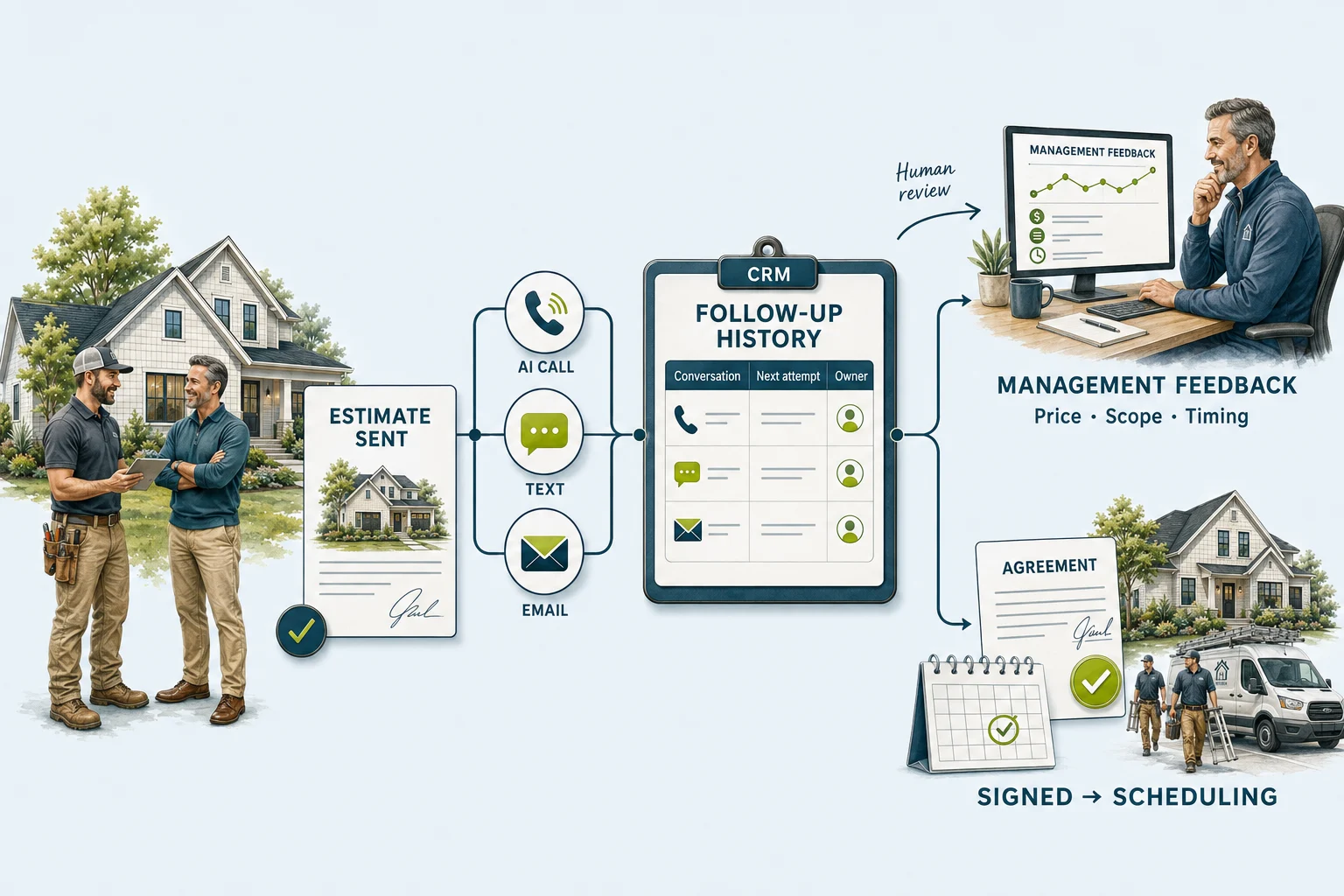
An unanswered estimate is an unfinished conversation.
Your salesperson measures the roof, prepares the scope and sends the estimate. A week later, the CRM still says “estimate sent.” That status tells management almost nothing. Is the homeowner comparing bids, unsure about financing, waiting until next month, or simply missing the email?
The next useful action depends on the answer. This proposed system follows eligible open estimates through AI calls, text and email, captures the customer’s response, and gives a person ownership of the decision that needs attention. It stops the sales sequence when the customer signs, declines or asks to stop.
Low calling costs make repeated follow-up practical to evaluate. The business value still depends on relevant conversations and reliable execution. Sending more messages without learning anything leaves the same uncertainty in a larger activity log.
What would your call usage cost?
Use total billable minutes per estimate across all follow-up attempts. Six minutes could mean two three-minute calls; actual usage depends on answers, call length and provider billing.
100 estimates × 6 minutes × $0.075
Client-specific configured rate.
Excludes setup, management, SMS, email, hosting and any separate provider charges. This is not a complete-system price.
One estimate. Every conversation. A next step.
Select a sample customer. These four independent fictional records demonstrate different outcomes; they are not the 100-estimate reporting cohort below.
| Customer | Status | Owner | Next attempt / task |
|---|---|---|---|
| EST-101 | Price question | Maya / Sales | Sep 11 · 2:00 PM CDT · Human callback |
| EST-102 | Timing | Alex / Sales | Oct 5 · 1:00 PM CDT · Requested check-in |
| EST-103 | No response | Sam / Sales | Sep 14 · 4:00 PM CDT · Eligible text follow-up |
| EST-104 | Installation handoff | Taylor / Scheduling | Sep 15 · 9:00 AM CDT · Confirm installation window |
Casey Brooks
Price question · Maya / Sales
Sep 11 · 2:00 PM CDT · Human callback
- EMAIL
Roof replacement estimate delivered.
Version 2 · $14,800 · Demo amount - AI CALL
Connected · Customer says another quote is lower.
DEMO-CALL-101 · Recording reference only; no audio - TEXT
Customer: “Does yours include replacing the flashing?”
Customer statement preserved · Scope question, not a confirmed lost sale - CRM
Assigned scope review to Maya. Automated sales attempts paused.
Next task Sep 11 at 2:00 PM CDT
Check flashing scope before discussing price. A lower competing quote may cover different work.
Review the underlying conversation before treating a summary as a verified customer reason.Packaged service prices and call usage answer different questions.
Some published AI-service plans sit at $699–$999 per month. Those are examples of specific packages, not an industry average. Here is how they differ from the $45 calling calculation.
| Example | Published or modeled amount | What the number covers |
|---|---|---|
| Raina Growth ↗ | $699/month | Published voice + SMS package: 700 voice minutes and 3,500 SMS. Listed overages: $0.75/minute and $0.035/SMS. Confirm suitability for outbound estimate follow-up. |
| Raina Pro ↗ | $999/month | Published package: 1,500 voice minutes and 8,000 SMS. These packages also provide a managed front-desk experience. |
| Alivo Agent Team ↗ | $999/month equivalent, billed annually | Phone and digital-lead agents with voice, SMS and email. Its estimate-follow-up and rehash agent is listed in Team Additions at another $499/month, billed annually. |
| GoodHandoff client-rate example | $45/month in AI calling usage | 100 estimates × 6 total billable minutes × $0.075/minute. Setup, management, SMS, email, hosting and any separate provider charges are excluded. |
Alivo’s listed base plus Team Additions totals $1,498 per month equivalent on annual billing. That includes a broader set of agents than this calling-only calculation. Its pricing page also lists higher month-to-month rates; check the current terms before budgeting.
A package may be the right purchase when the included product, support and integrations fit your process. A custom workflow is worth evaluating when you need different ownership rules, reporting or connections. We are not claiming equal functionality for $45 or calculating a savings percentage from unlike cost categories.
Make the minute assumption explicit.
At three billable minutes per estimate, 100 estimates produce 300 minutes and $22.50 of AI-call usage. At six minutes, the result is $45. At ten minutes, it is $75. Those are usage scenarios, not forecasts of answers or sales. Check how the configured provider bills short calls, voicemail, rounding and other charges before using the model as a budget.
Ask what is holding up the decision.
For Casey’s roofing estimate, the first useful question is whether the scope makes sense. Casey says another quote is lower, then asks whether flashing is included. That gives the salesperson a specific comparison to clarify. An automatic discount would skip the actual issue.
A timing response belongs on a dated callback task. A financing question goes to the authorized person who can explain available options. No response remains “unknown,” rather than becoming a made-up objection in the dashboard.
Use approved source information for prices, scope and warranty details. The AI should not negotiate a discount, promise financing approval or commit a crew date. Its job is to surface the question, preserve the conversation and get the right person involved.
Useful messages sound like a continuation of the estimate.
Text / scope check
“Hi Casey, this is Example Roofing following up on your roof estimate. Is there anything in the scope you’d like us to explain before you decide? Reply STOP to opt out.”
Email / comparing bids
“Subject: A question about your roof estimate
You mentioned comparing proposals. If it would help, Maya can walk through the flashing, ventilation and cleanup included in ours. What part would you like to compare?”
AI call / human handoff
“I’m the AI assistant for Example Roofing, following up on your estimate. I can note your questions for Maya. Would you like her to call about the scope?”
These are fictional examples for an eligible campaign. Identify the sender and preserve the customer’s contact preferences. For AI telemarketing calls, review the applicable written-consent requirements described in the FCC’s AI-voice ruling; commercial email must follow the FTC’s email requirements. A supplied phone number alone should not enroll every estimate in every channel.
“We followed up” is not enough.
Give management a short list of decisions to make, supported by the original conversation. Separate what customers actually said from the system’s interpretation.
Where the open decisions stand
Three decisions for this week
Scope clarity: review the price/scope group for repeated unanswered questions before changing the offer.
Capacity: check whether timing requests match real installation availability.
Ownership: review overdue human tasks so an answered AI call does not become an unattended handoff.
Track movement, not just attempts.
This sample has 12 signed agreements out of 100 estimates: a 12% signed-estimate rate at the review date. That is not a completed-job rate and does not show a lift caused by automation. Track booked follow-up appointments, signed agreements, cancellations and completed paid jobs separately.
To evaluate improvement, compare cohorts with similar estimate age, job type and lead source, allowing enough time for decisions. Include a baseline or suitable holdout where practical. Review whether follow-up creates additional wins, shortens time to a decision or simply records outcomes the team would have achieved anyway.
When the customer signs, the next owner changes.
Riley asks for the signing link. Once the signed agreement and required deposit are confirmed, the CRM stops estimate-chasing messages and creates an installation handoff. Taylor in scheduling accepts the task. Until that acceptance is recorded, the handoff remains open.
Carry the accepted scope version, product selections, property details, payment milestone and customer availability into the scheduling record. Flag unresolved questions instead of burying them in a call summary.
The customer receives an installation date only after the scheduling team confirms it. The system can help keep that promise visible; it cannot infer crew availability from a successful sale.
What we would build around your estimates.
Start with the CRM’s estimate status, your approved follow-up rules and the team members who handle price, scope and scheduling questions. Connect eligible records to the chosen communication providers, write each result back to the estimate, and give management a view of open decisions and overdue tasks.
Test the paths that change the sequence: a reply during a queued attempt, a revised estimate, a stop request, a duplicate provider event and a failed CRM update. A retry should repair the missing record without repeating the customer contact. Then verify a permitted pilot against actual delivery, call and CRM records.
The calling calculation is one input to the decision. The finished workflow also needs setup, ownership and ongoing operation. The project scope should state those responsibilities and costs before activation.
Find out why estimates stall.
Give the next step an owner.
Bring your CRM, monthly estimate volume and current follow-up process. We’ll map calls, texts, email, management feedback and the handoff to scheduling.
Talk through my estimate follow-up ↗