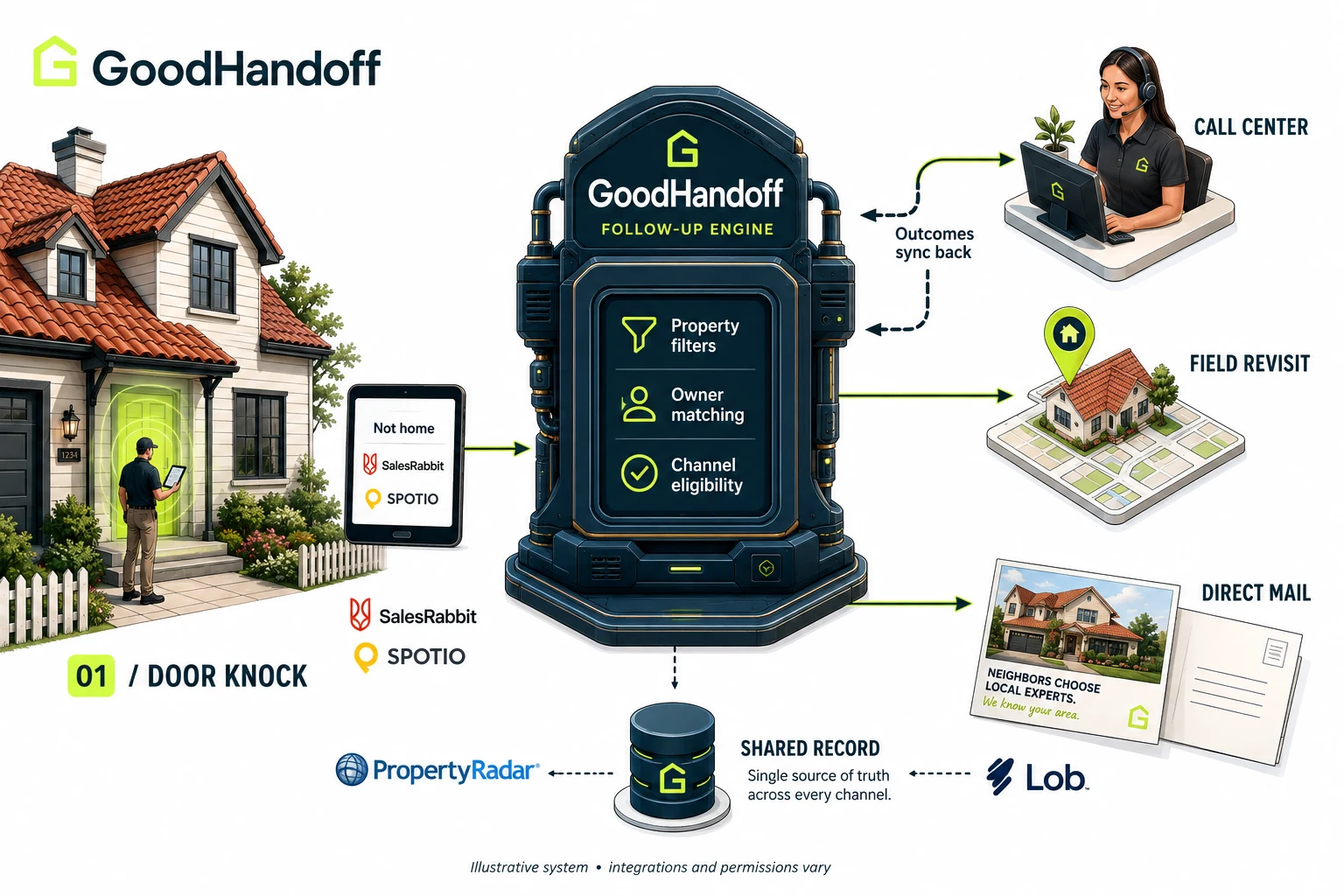
A knock starts the record. The follow-up keeps it moving.
Turn door-knocking results into eligible phone outreach, better-timed field revisits, and postcards that match the conversation.
Illustrative architecture. Provider access, data licensing and channel permissions determine the available connections.
The neighborhood has already told you something.
Your rep spent the afternoon knocking doors. Some homeowners were out. One asked for a callback after work. Another wanted information before scheduling an inspection. Those are different outcomes—and each deserves a different next step.
This proposed system takes the result recorded in a canvassing app and turns it into an owned action. It carries the address, original rep, doorstep notes and latest disposition into the call center, the CRM and the mail campaign. When a conversation changes, the other teams see it.
A useful doorstep result needs more than “not interested.”
The first design decision is the result list your reps use. “Not home,” “renter,” “requested information,” “call me next month,” and “do not contact” describe different situations. Collapsing them into a generic unsuccessful knock makes the follow-up less relevant and gives the office more guessing to do.
Keep the choices short enough to use on a doorstep, with a note field for the details that change the next action. A callback request needs a time window and the contact information the homeowner supplied. A renter response needs a clear distinction between the resident and the owner. A stop request needs its scope recorded and passed to the appropriate queues.
The record should retain the original rep, knock time, source lead ID, address, and permission evidence where captured. The current status can change; the original observation should remain in the history. That lets the call center understand why it received the record and lets the field manager review what happened without relying on a rep's memory.
01 / QUALIFY THE PROPERTY
Filter before paying to enrich or contact.
Start with your service area, property type and minimum estimated property value. A property below the agreed threshold exits the campaign before a phone lookup or postcard order.
Estimated market value, assessed value and last sale price are different fields. The build should use the one you choose, keep its source and date, and send missing values to review.
For an eligible address, an approved data provider can return owner information and available phone numbers. A match needs validation: a number attached to a property may belong to a former owner or someone who does not make the decision.
Demo rules only. Property value never overrides a stop request. Approval here represents a completed review, not a legal determination by this calculator.
A property match is not automatically a homeowner match.
Suppose a rep logs 24 Example Lane. Before buying contact data, the engine standardizes the address and looks for an existing household record. A second knock at the same property becomes another event on that record, rather than another paid lookup and another postcard enrollment.
Next comes the owner match. The property may be owner-occupied, rented, held by a company, or recently sold. A data provider can return useful candidates, but the system should preserve uncertainty instead of labeling every returned number “homeowner.” Low-confidence matches, conflicting ownership records, and incomplete addresses go to review.
If a number is wrong, the call-center disposition must update the shared record. Otherwise, tomorrow's import can put that same number back into the queue. A corrected match should also retain the previous lookup date and rejection reason so the team can audit the change.
Example: a $300,000 minimum value.
A property estimated at $275,000 is excluded under this sample campaign rule. A $425,000 property continues to the next checks. A property with no reliable estimate is held for review. The threshold controls campaign spending; it does not establish the homeowner's interest, ability to pay, or calling permission.
Filter first, then enrich the records that remain. Store the provider response and its permitted reuse period so routine syncs do not repeatedly purchase the same data. Data licensing, API allowances, and lookup charges belong in the implementation scope.
02 / HAND OFF THE CONTEXT
The call center gets the story—not just a phone number.
The agent sees the original knock, the rep's notes, the requested callback window and the current eligibility status. Each call has an owner, outcome and next action. External call centers return those fields through an agreed API or import format.
If the homeowner wants a visit, the system sends that warm lead back to the field team. If the rep books at the door first, the cold-call task closes. Repeated provider events should update the same household, not create another campaign enrollment.
A DNC check is a gate, not blanket permission.
The calling lane includes current national and applicable state screening, company-specific suppression, contact permissions and local calling rules. This example uses human call-center agents. AI-voice telemarketing requires a separate consent assessment.
FTC telemarketing guidance specifies National Registry data no more than 31 days old at the time of a call. The client's compliance owner approves the actual policy.
HOUSEHOLD GH-DEMO-204Fictional record
Property
24 Example Lane
Field rep
Maya • North route
Queue
Warm field revisit
Next action
Sep 10 • 5:30 PM CDT
Call campaign
Paused • visit booked
Mail campaign
Acquisition mail stopped
Door knock / not homeRep saved the address and route reference.
Human-agent call / connectedHomeowner requested a field visit after work.
Field handoff / acceptedMaya accepted the revisit. Cold outreach paused.
“Sent to the call center” is only the start of the handoff.
A successful export proves that a file or request was sent. It does not prove that an agent received an actionable lead. The receiving system should acknowledge the household ID, assigned campaign, record acceptance, and any rejected fields. The office needs to see records that were rejected or never acknowledged.
For an internal team, the queue can sit in the existing CRM or calling platform. For an external center, agree on the inbound fields and the return format before building the connector. At minimum, outcomes should distinguish no answer, wrong number, callback requested, interested, appointment booked, and stop requested. A generic “completed” label is not enough.
During the call, the agent should know whether the rep actually spoke to someone. A not-home lead calls for an introduction; a requested callback calls for continuing the homeowner's stated inquiry. The script should never invent a previous conversation or imply that an inspection found a problem.
Each return event carries a timestamp, agent or team, call reference, outcome, and next action. Where recording is enabled and permitted, its reference stays with the call record. The next attempt belongs in a dedicated scheduling field, not buried in a paragraph of notes.
Give the warm lead to a person who accepts it.
When a homeowner asks for a visit, the engine sends the field team the address, service interest, preferred time, and call notes. The task stays unassigned or awaiting acceptance until a rep takes ownership. A warm lead should not look handled just because a notification went out.
In our fictional record, Maya accepts the September 10 revisit at 5:30 PM. That acceptance updates the shared appointment state and pauses cold outreach. If the appointment changes, the call center sees the new state. If Maya cannot take it, a manager gets a reassignment task instead of leaving the homeowner waiting.
03 / MATCH THE MAIL TO THE RESULT
One campaign does not mean one postcard.
The postcard should make sense after the latest conversation. Use approved templates, a validated mailing address and a frequency limit. Recheck the household status before ordering a new piece; mail already in production may be too late to cancel.
DEMO CONTRACTOR / NOT HOME
Sorry we missed you.
Have a roofing project on your list? Choose a time to talk with our local team.
Your booking link goes here →
⌂
Trigger: no doorstep conversation. A company introduction and clear next step. Do not suggest the homeowner spoke with the rep or that the roof has damage.
DEMO CONTRACTOR / INFORMATION REQUESTED
A little more detail. A clearer next step.
Explore our process, what an inspection includes, and how to choose a convenient time.
Your service guide goes here →
⌂
Trigger: homeowner requested information. Send the relevant service guide. Stop the acquisition sequence when an appointment is booked or a relevant opt-out arrives.
Illustrative postcard concepts—not print-ready mail. Final artwork needs the client's identity, actual offer, mailing layout and a working tracked URL or QR code.
Lob's API supports postcard creation and tracking. A mail-provider status records production or delivery progress; it does not prove the homeowner read the piece.
The postcard schedule should listen to the conversation.
Mail works on a different clock from phone outreach. The engine may create a draft when a knock is logged, then wait until a scheduled release to check the latest status and submit the order. A call or doorstep conversation during that interval can change the template or cancel the planned piece.
For a not-home result, the card introduces the contractor and offers a clear way to request information. For an information request, it points to the relevant service guide. A “call me next month” record should respect that timing. A booked appointment leaves the acquisition campaign; any appointment information is a separate communication with a different purpose.
Set a household-level frequency limit so multiple reps, repeated imports, or adjacent campaigns do not order overlapping postcards. Keep the template version, mailing address, order ID, cost, and production status with each piece. Once a provider has started production, cancellation may no longer be possible; show that limitation to the operator rather than marking the piece canceled when it will still arrive.
A unique response URL, QR code, or tracking number can connect a response to the campaign. When the homeowner calls, the agent should see the relevant card and offer. When the homeowner books online, the appointment should reach the same household record the field team already uses.
A shared record keeps teams from competing for the same lead.
The field team owns doorstep observations. The call center owns call attempts and dispositions. The CRM holds the agreed contact, opportunity and appointment records. Each integration keeps durable IDs so updates return to the right household.
A new stop request must reach every applicable queue. A failed CRM write should create a repair task without repeating a call. A wrong-number report should suppress that number and send the match for review. Those exceptions are part of the build.
04 / FOLLOW THE HOUSEHOLD THROUGH THE FUNNEL
Measure what the extra follow-up actually adds.
Doors & households
Count distinct households separately from repeat knocks.
Eligibility & contact
Show exclusions, matched numbers, attempted calls and two-way conversations.
Appointments & visits
Separate requested, booked and held appointments. Preserve the field handoff.
Sales & campaign costs
Connect won jobs to calling and mailing spend, with open opportunities visible.
A postcard scan or tracked call is evidence of a response. It is not proof that the postcard caused the sale. To estimate incremental lift, compare suitable groups with and without added follow-up, while accounting for timing and audience differences.
Measure the exclusions as carefully as the appointments.
For a fictional batch of 1,000 distinct households, suppose 250 fall outside the property criteria and 100 need data review. That leaves 650 for the next stage. If 400 have an approved phone match and calling eligibility, the calling denominator is 400—not all 1,000 doors and not the number of dial attempts.
If those 400 households produce 120 two-way conversations, the contact rate is 30%. If 24 book an appointment, the booking rate is 6% of eligible households and 20% of conversations. Both measures are useful, but they answer different questions. Label them clearly and show how many appointments were actually held.
Mail has its own eligible audience, which may overlap with the calling audience. Never add the two channel totals and present the result as unique households. Report mail orders, provider delivery events, tracked responses, appointments, and sold jobs separately, with the dates and unresolved opportunities visible.
Campaign cost should include the relevant data purchases, screening, call-center charges, printing and postage. If you present a fully loaded cost per appointment, add the applicable labor and system costs too. Keep booked revenue separate from collected revenue. These are reporting definitions for the proposed build, not claims about an achieved customer result.
Start with one route and prove the complete loop.
The first rollout should use a bounded territory, an agreed disposition list, one call-center workflow, and a small set of approved postcard templates. Before live outreach, replay fictional records through the system to confirm that below-threshold properties are excluded, uncertain matches are held, duplicate events stay single, and stop requests reach every applicable queue.
Then test the return path: an agent books a visit, the field rep accepts it, the CRM shows the appointment, and the pending acquisition outreach stops. Test a failed update as well. The record should remain visibly unfinished until the destination confirms the repair.
That is the value of the custom build: the canvassing app, contact data, call center, mail provider, and CRM can each do their job while sharing a reliable account of what the household needs next. The business keeps control of its accounts, campaign rules, templates, and operating history.
BUILD AROUND YOUR FIELD TEAM
What happens after your reps leave the street?
Bring your canvassing app, call-center process and current follow-up rules. We’ll map the connections and the handoffs that need an owner.